PAG GLOBAL FINANCIAL INSTRUMENTS GOVERNANCE FRAMEWORK (FIGF)
Prepared for Pacific Alliance Group (PAG) and Zarif Menon & Associates (ZMA)
Purpose
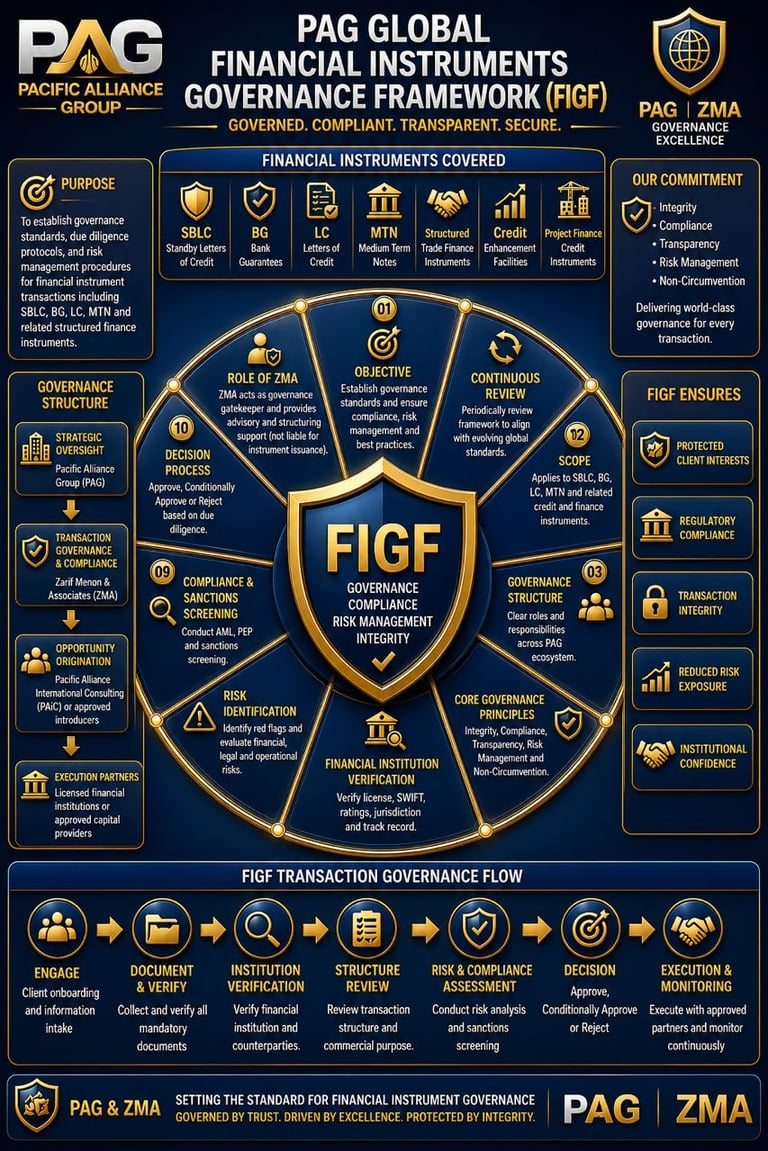
To establish governance standards, due diligence protocols, and risk management procedures for financial instrument transactions including SBLC, BG, LC, MTN and related structured finance instruments.
1.) Objective
This framework establishes the governance structure used by PAG and ZMA when reviewing and conducting governance and risk assessments of proposed transactions involving instruments. It ensures that all transactions meet international banking standards, compliance obligations, and risk management principles consistent with Tier‑1 family office practices.
2.) Scope
This framework applies to all proposed transactions involving:
Standby Letters of Credit (SBLC)
Bank Guarantees (BG)
Letters of Credit (LC)
Medium Term Notes (MTN)
Structured Trade Finance Instruments
Credit Enhancement Facilities
Project Finance Credit Instruments
3.) Governance Structure
The governance structure for financial instrument transactions within PAG is as follows:
Strategic Oversight: Pacific Alliance Group (PAG)
Transaction Governance and Compliance: Zarif Menon & Associates (ZMA)
Initial Intake and Preliminary Screening: Pacific Alliance International Consulting (PAiC) or approved referral channels
Independent Transaction Counterparties: Appropriately licensed, regulated or otherwise legally authorised institutions, as applicable to the relevant jurisdiction and trasaction
7.) Transaction Structure Review
All proposed structures must be assessed to confirm:
Commercial purpose of the instrument
Real trade or project underlying the request
Market‑consistent issuance fees
Logical payment flows
Clear contractual responsibilities
4.) Core Governance Principles
PAG adopts the following core principles when reviewing financial instrument transactions:
Integrity – Transactions must involve legitimate counterparties and transparent structures.
Compliance – All transactions must comply with AML, KYC, FATF and international banking regulations.
Transparency – All parties must disclose their roles clearly.
Risk Management – Transactions must be screened for financial, legal and operational risk.
Non‑Circumvention – All intermediaries must be protected through proper contractual frameworks.
5.) Mandatory Documentation
Before PAG or ZMA accepts an advisory, governance or risk-review mandate concerning a proposed financial instrument transaction, the following documentation must be obtained and reviewed:
Client Information Summary (CIS)
Corporate Registration Documents
Passport / Identification of Directors
Bank Account Confirmation
Draft Instrument Verbiage
Issuing Bank Details
Transaction Purpose Documentation
6.) Financial Institution Verification
The issuing financial institution must be verified through the following checks:
Regulatory license verification
SWIFT capability confirmation
Bank credit rating review
Jurisdiction risk review
Historical transaction track record
8.) Risk Identification
Transactions must be reviewed for potential red flags including:
Offshore shell issuers with no regulatory license
Excessive upfront fees
Absence of identifiable issuing bank
Claims of “private banking instruments” outside SWIFT system
9.) Compliance and Sanction Screening
All parties must undergo sanctions screening including:
FATF jurisdiction analysis
Politically Exposed Person (PEP) checks
Global sanctions database screening
AML compliance review
10.) Decision Process
Following due diligence, PAG/ZMA shall classify the transaction as:
Governance Review Completed – No material governance objection identified within the defined scope of review
(NOTE: This classification does not constitute regulatory approval, investment advise, credit approval, bank confirmation, or a recommendation to transact.)
Conditional Approval – Additional verification required
Rejected – High risk or non‑compliant structure
11.) Role of ZMA
Zarif Menon & Associates shall act as governance and compliance gatekeeper for PAG‑related financial instrument transactions. ZMA may provide facilitation, advisory, or structuring support but shall not assume banking or financial liability for instrument issuance.
12.) Continuous Review
This governance framework shall be reviewed periodically to ensure alignment with evolving international banking practices and regulatory expectations.